Table of Contents
ToggleWhen an Amana dishwasher stops cleaning properly, it’s frustrating, especially when you’ve just run a full cycle and still find food residue, film, or grime on supposedly clean dishes. Before calling a repair tech or shopping for a replacement, understand that most cleaning issues stem from a handful of fixable problems: clogged components, poor water flow, or user error in loading and detergent use. This guide walks through seven practical troubleshooting steps to restore your Amana dishwasher’s cleaning performance, starting with the simplest fixes and moving toward slightly more involved diagnostics.
Key Takeaways
- Clogged spray arms and dirty filters are the most common causes of Amana dishwasher not cleaning properly, and both can be fixed quickly by removing debris and mineral deposits with vinegar and hot water.
- Water temperature must reach 120–150°F for detergent to dissolve effectively—if your hot water is below this threshold, adjust your water heater thermostat to restore cleaning performance.
- Improper loading and detergent usage are major culprits: avoid overloading, don’t block the spray arms or detergent dispenser door, and always use the correct detergent amount for your water hardness level.
- Inspect your inlet valve and water supply line for clogs, mineral buildup, or partially closed shutoff valves, which restrict water flow and compromise dishwasher cleaning results.
- Hard water requires additional rinse aid or more detergent, while soft water needs less detergent—test your water hardness to optimize cleaning without leaving residue.
Check and Clean the Spray Arms
The spray arms distribute water throughout the dishwasher. If they’re clogged or can’t rotate freely, water won’t reach all the dishes. Pull out the bottom rack and locate the lower spray arm, it typically snaps or unscrews off. Check the upper spray arm by removing the top rack.
Inspect each spray arm for food particles, mineral deposits, or debris blocking the spray nozzles. Use a toothpick or small wire to clear any obstructions. Rinse the arms under running water.
Spin each spray arm by hand after reinstalling to confirm smooth rotation. If they wobble or catch on the rack tines, adjust your dish placement. Blocked or immobile spray arms are one of the most common dishwasher problems homeowners encounter, and thankfully one of the easiest to fix.
If mineral buildup is heavy (white or chalky deposits), soak the spray arms in a 50/50 mix of white vinegar and warm water for 30 minutes, then scrub gently with an old toothbrush.
Inspect the Dishwasher Filter for Clogs
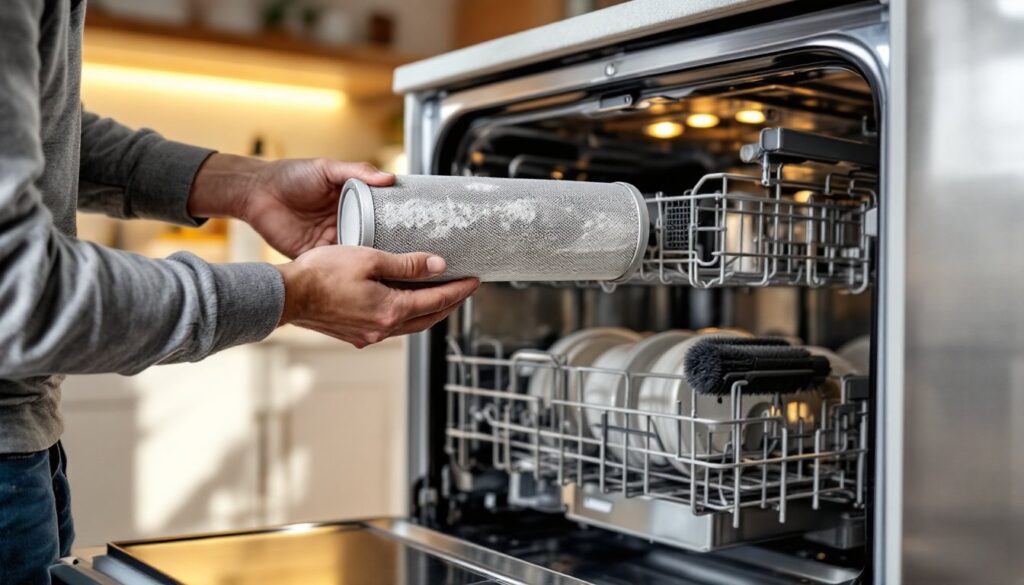
Amana dishwashers use a cylindrical filter assembly at the bottom of the tub to catch food particles before they recirculate. A clogged filter restricts water flow and leaves dishes dirty.
To access the filter, remove the bottom rack. Twist the cylindrical filter counterclockwise (most Amana models use a quarter-turn lock). Lift out the filter and the flat screen or fine mesh filter beneath it.
Rinse both components under hot running water. Use a soft brush or sponge to remove grease and stuck-on debris, avoid steel wool, which can damage the mesh. If there’s a significant buildup of food waste, it’s a sign the filter hasn’t been cleaned in a while.
How often to clean: Every 1–2 months under normal use, or weekly if you regularly scrape (but don’t rinse) heavily soiled dishes. A dirty filter is the culprit behind many dishwasher cleaning issues, even when other components work fine.
Reinstall the filter by aligning the arrows or tabs and twisting clockwise until it locks. A loose filter can rattle or allow debris to bypass filtration.
Ensure Proper Water Temperature and Pressure
Dishwasher detergent, especially powder and tablet forms, requires water at 120–150°F to dissolve and activate effectively. If your water heater is set too low, detergent won’t break down grease, and enzymes won’t work.
Test your hot water: Run the kitchen faucet closest to the dishwasher until the water is fully hot, then fill a glass and use a cooking thermometer. If it reads below 120°F, adjust your water heater thermostat. Most residential water heaters have a dial or digital control: raising it 10°F can make a noticeable difference.
Water pressure also matters. Low pressure reduces the force and volume of water hitting the dishes. Check whether your home’s water pressure is sufficient (typically 20–120 psi, with 40–60 psi ideal). If you notice weak flow at multiple faucets, the issue may be a partially closed main shutoff valve, a pressure regulator problem, or sediment in the supply line.
Run the kitchen faucet for 30 seconds before starting the dishwasher to ensure hot water reaches the appliance immediately. Cold water at the start of a cycle hampers cleaning performance, especially on short cycles.
Evaluate Your Detergent and Loading Technique
Even a perfectly functioning dishwasher won’t clean well if you’re using the wrong detergent, too much or too little of it, or loading dishes in a way that blocks water flow.
Using the Right Detergent Type and Amount
Amana dishwashers work with powder, gel, tablet, or pod detergents. Tablets and pods are pre-measured, which reduces guesswork, but they require sufficient water temperature to dissolve fully.
If you’re using powder or gel, follow the fill lines in the detergent dispenser. Overfilling doesn’t improve cleaning, it leaves residue. Underfilling means dishes don’t get enough surfactant and enzymes to cut grease.
Check the expiration or “best by” date on detergent packaging. Powder detergent can clump and lose potency if exposed to humidity. Store it in a cool, dry place, not under the sink if there’s a plumbing leak risk.
Consider your water hardness. Hard water (high mineral content) requires more detergent or the addition of a rinse aid to prevent spotting and film. Soft water needs less detergent. If you’re unsure, test strips are inexpensive and available at hardware stores or kitchen supply retailers.
Avoiding Overloading and Blocking Spray Zones
Overloading is the most common user error. Dishes need space for water and detergent to reach all surfaces. Nesting bowls or stacking plates too tightly creates “shadow zones” where spray can’t penetrate.
Place larger items (pots, mixing bowls, cutting boards) on the bottom rack along the sides, never in the center, where they can block the spray arm. Angle bowls and cups downward so water drains rather than pooling.
Silverware should go in the basket with handles down (except knives, handles up for safety). Alternate the direction of spoons to prevent nesting. Don’t cram utensils: if the basket is full, run a second load.
Avoid blocking the detergent dispenser door. If a large plate or baking sheet prevents it from opening fully, the detergent won’t release on time, and cleaning suffers.
Examine the Inlet Valve and Water Supply
The inlet valve controls water flow into the dishwasher. If it’s clogged, partially closed, or failing, the machine won’t fill properly, leading to weak cleaning performance or a cycle that doesn’t start.
Turn off the dishwasher and locate the water supply line, typically under the sink or behind the dishwasher’s kickplate. Check that the shutoff valve is fully open (turn counterclockwise). A partially closed valve is an easy oversight during plumbing work or a kitchen remodel.
Disconnect the supply line from the inlet valve (you’ll need a bucket and towel, some water will spill). Inspect the inlet screen, a small mesh filter inside the valve’s threaded port. Use needle-nose pliers to remove it carefully, then rinse under water and gently brush away sediment or mineral buildup.
If the screen is damaged or the valve itself shows signs of corrosion or leaking, replacement is necessary. Inlet valves are relatively inexpensive ($20–$40 for the part) and a straightforward swap if you’re comfortable with basic plumbing and electrical connections. Safety first: Shut off water and power at the breaker before working on the valve.
If you’re not confident working with water lines and electrical components, call a licensed appliance repair tech. A faulty inlet valve can cause water leaks or electrical shorts, this isn’t the place to learn by trial and error.
After addressing the inlet valve, run a test cycle. Listen for the sound of water entering the tub. If flow seems normal and the dishwasher fills to the correct level (water should just touch the heating element on most models), you’ve likely solved the problem.